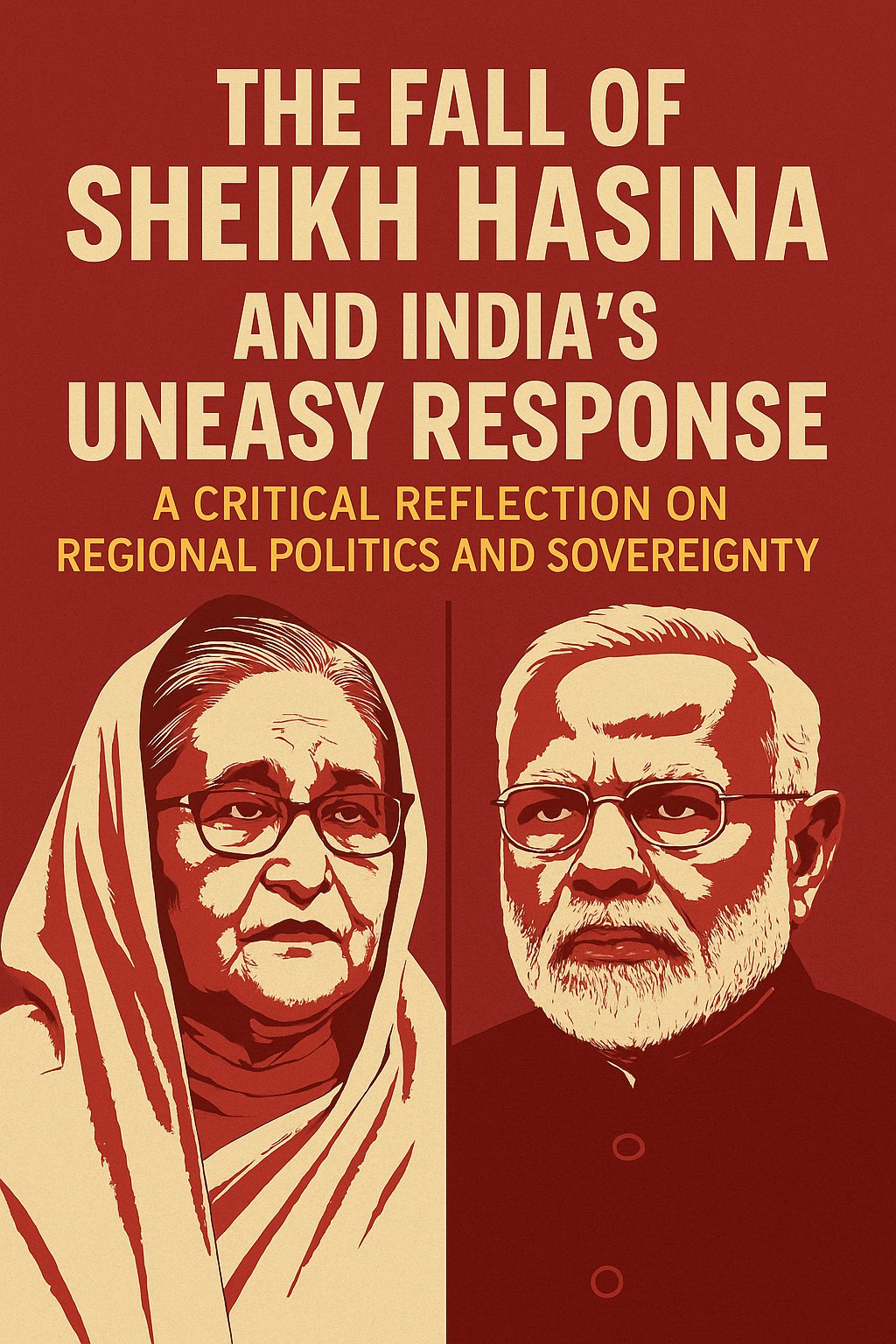
The Fall of Sheikh Hasina and Bangladesh’s Democratic Transition
The sudden departure of Sheikh Hasina the notorious murderer of democracy, widely criticized as the authoritarian figurehead who is mothered democracy in Bangladesh for over fifteen years, has marked a historic turning point for the nation. Fleeing to India after a powerful and unprecedented student-led uprising that captured global attention, her fall signaled the end of a long, repressive chapter in Bangladesh’s history. With her removal, a wave of relief has swept across the nation. Citizens from all walks of life, regardless of religion, ethnicity, or class are beginning to feel a renewed sense of hope and democratic aspiration. The oppressive weight that had long crushed political freedom and civil rights has been lifted by a collective surge of public resistance. For the first time in over a decade, there is a visible national awakening a chance to redefine governance through the will of the people.
India’s Political Discomfort and Strategic Loss
The collapse of Sheikh Hasina’s regime has not only shifted the political landscape within Bangladesh but has also deeply unsettled New Delhi. India’s ruling establishment is visibly agitated, as it had cultivated an asymmetric relationship with the Hasina government that served its regional ambitions. For years, India enjoyed a virtually unchallenged influence over Bangladesh, treating it as a quasi-dependent satellite state. Hasina functioned as a strategic proxy ensuring Indian interests were safeguarded while Bangladesh’s sovereignty was compromised. Now, with her gone, India’s sense of control is unraveling. Strategic anxieties are rising as India scrambles to reassert influence exploring aggressive ideas such as drawing Bangladesh into its “Eight Sister States” narrative. This growing unease is not only geopolitical but psychological, as India grapples with the loss of a reliable regional ally who once handed over Bangladesh’s autonomy on a silver platter.
Modi’s Reaction and Indian Media’s Propaganda Blitz
Following Hasina’s exit, India’s response particularly from the ruling BJP and its affiliated media has taken on a tone of desperation. A relentless wave of propaganda has been launched, filled with distortion, misinformation, and politically charged narratives. Indian mainstream outlets have gone into overdrive, portraying the student uprising and democratic transition as a ‘destabilizing’ threat, rather than a moment of national renewal. Prime Minister Modi and his ideological allies appear personally stung by Hasina’s downfall, treating it not as an internal matter of a sovereign neighbor, but as a blow to their own political dominion. This reaction betrays the depth of India’s entanglement in Bangladesh’s internal politics and raises urgent questions about Delhi’s respect for its neighbors’ self-determination. The behavior displayed is not just diplomatically inappropriate it is an alarming display of neo-colonial arrogance masquerading as regional concern.
Hindu Extremism and Legal Anarchy in Bangladesh
India’s manufactured outrage over supposed minority persecution, shocking acts of extremism from within their own sphere of influence in Bangladesh are conveniently ignored. The brutal killing of young lawyer Saiful Islam by followers of a radical Hindu religious figure, Chinmoy Krishna Das Brahmachari, exemplifies this selective outrage. These extremists openly defied the law, bypassed judicial authority, and carried out vigilante violence in broad daylight. Yet the Indian government so vocal about minority rights elsewhere remained deafeningly silent. This hypocrisy reveals that India’s concern for minorities in Bangladesh is not driven by humanitarian principles, but by opportunistic political calculations. When actual lawlessness occurs, especially involving Hindu militants, India refuses to acknowledge it, further discrediting its moral posture.
India’s Silent Endorsement of Autocracy
Over the past decade and a half, India has demonstrated a consistent pattern of turning a blind eye to the systematic erosion of democracy in Bangladesh under Sheikh Hasina’s rule. From the blood-soaked Pilkhana massacre to the lethal crackdown at Shapla Chattar, from mass enforced disappearances to farcical, voter-less elections India stood by as a silent spectator, if not an implicit enabler. Far from condemning these atrocities, India lent credibility to them through diplomatic recognition and public endorsements. This quiet complicity reflects a disturbing willingness to prioritize geopolitical convenience over democratic values. By propping up Hasina’s regime, India sacrificed its credibility as a champion of democracy and chose authoritarian stability over principled foreign policy.
Communal Harmony in Bangladesh vs. India’s Communal Bias
Bangladesh has long been a model of religious and ethnic coexistence in South Asia. Despite being a Muslim-majority nation, it has preserved a proud legacy of pluralism, with Hindus, Christians, Buddhists, and indigenous groups living in harmony for generations. However, India’s external narrative deliberately distorts this reality, selectively highlighting issues concerning only one community while ignoring the broader context of unity. This one-sided advocacy serves neither the interests of Hindus in Bangladesh nor the cause of communal harmony. In fact, it fuels mistrust and attempts to fracture Bangladesh’s secular social fabric. The truth is that India’s concern is neither inclusive nor genuine it is a political tool, misused to manipulate perceptions and justify interference. Even within Bangladesh, the majority of the Hindu community rejects this divisive approach and affirms their shared identity as Bangladeshis first.
Survey Data Debunks Indian Allegations
A credible and impartial survey conducted by Voice of America (VOA) an international outlet beyond the reach of local influence has decisively countered India’s narrative. According to the findings, 64.1% of respondents believe that the current interim government provides better protection to religious and ethnic minorities than the former Hasina-led administration. This is not a fringe opinion but a statistically grounded reflection of national sentiment. The results expose the hollowness of India’s allegations and affirm that Bangladesh’s new administration is perceived as more inclusive and safer for minorities. It’s a stark reminder that India’s rhetoric is built not on facts, but on fear-mongering and manufactured grievance.
India’s Own Human Rights Violations Against Minorities
While India lectures Bangladesh on minority rights, it fails to confront the deep and ongoing communal crises within its own borders. Muslims face routine lynchings, discriminatory laws, and systemic state-backed violence. Bulldozers tear down minority neighborhoods without due process, while right-wing mobs act with impunity. Christians, too, are under siege especially in regions like Assam and Manipur where places of worship have been burned, communities displaced, and lives destroyed. More than 250 churches torched, over 200 people killed, and 60,000 displaced in Manipur alone should be enough to trigger outrage, yet the Indian state remains unmoved. This grotesque double standard makes India’s criticism of Bangladesh not only invalid but morally bankrupt. One cannot demand justice abroad while suffocating it at home.
The Ziaur Rahman Assassination and India’s Covert Role
Historical records and investigative journalism have long hinted at India’s involvement in covert operations targeting sovereign Bangladeshi leadership. One of the most explosive revelations concerns the assassination of President Ziaur Rahman. Reports indicate that the Central Intelligence Unit of India—JOD—opened a file aimed at eliminating Zia. While this plot was paused during Morarji Desai’s tenure, it was allegedly revived under Indira Gandhi’s government, culminating in Ziaur Rahman’s murder on May 30, 1981. This information, published in the Indian magazine Sunday by journalist Subramanyam, raises profound concerns about India’s long-standing interference in Bangladesh’s political evolution. It serves as a stark reminder that beneath the rhetoric of friendship, there often lies a strategy of control.
Indian Media, Extremism, and Bangladesh-Bashing
A significant segment of India’s media has devolved into a propaganda arm for state-backed communalism. These outlets, often in tandem with radical Hindutva groups, have launched aggressive campaigns to demonize Bangladesh and its interim leadership. Fabricated reports, doctored images, and inflammatory rhetoric are used to portray Bangladesh as a failed state on the brink of collapse. The goal is clear: to delegitimize the current transition and rehabilitate Hasina’s tarnished legacy. This strategy of psychological warfare and diplomatic sabotage is not just unethical, it’s dangerous. It aims to isolate Bangladesh internationally while sowing division within. However, the resilience of the Bangladeshi people and their deep-rooted sense of unity continue to counteract these external attempts at destabilization.

